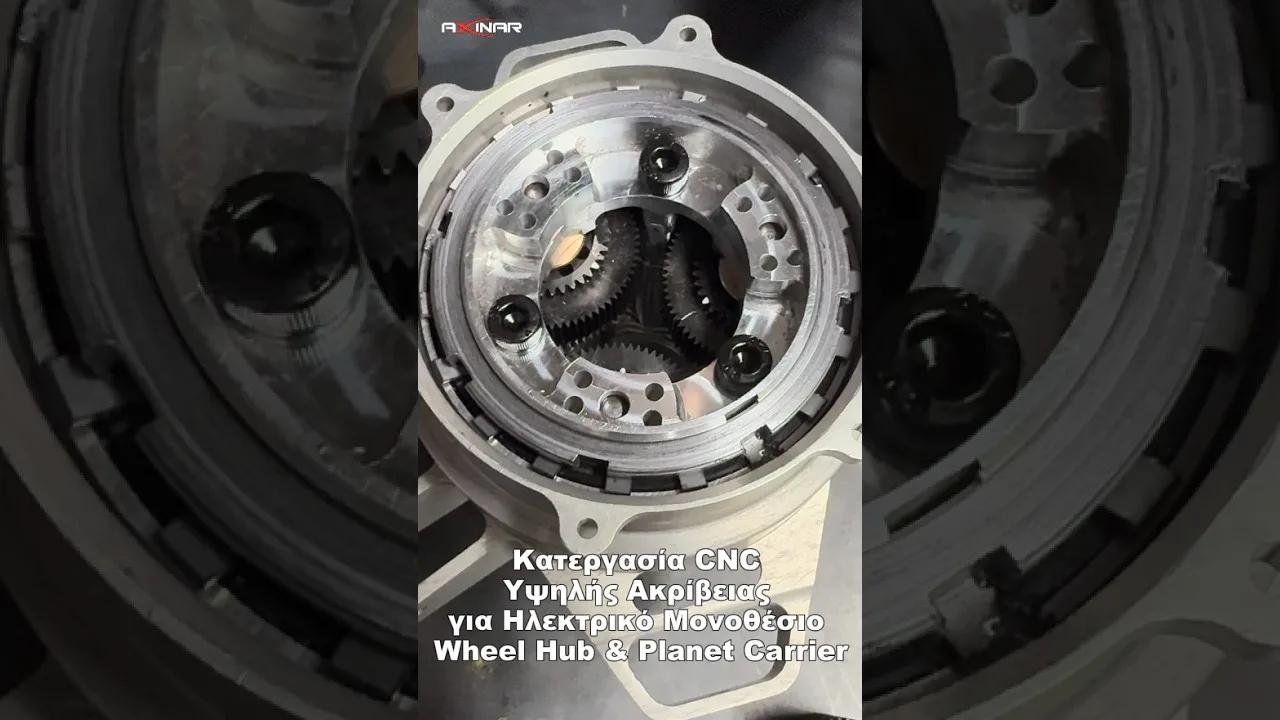
When ARISTURTLE, the Formula Student team of the Aristotle University of Thessaloniki (AUTh), asked us to machine the wheel hub and the planet carrier for their new electric race car “Rea,” the brief was clear: complex aluminum geometry, tight tolerances, concentricity maintained across two machining setups. This case study walks through how we approached the job, what was asked, how we solved it, what we learned.
What we were asked to do
ARISTURTLE sent us 3D STEP files for two parts critical to the in-wheel drivetrain of the “Rea” race car:
- The planet carrier, which holds the planet gears of the reduction set
- The wheel hub, which connects the wheel to the in-wheel 35 kW electric motor
Both designed by ARISTURTLE’s engineers, with internal pockets, precise seats for gears and bearings, and a requirement to be machined from two sides, with concentricity preserved across re-fixturing.
“The parts we handed to AXINAR for machining were particularly complex. Because of the difficult geometry, the operations required, and the precision needed.”
Engineer from ARISTURTLE, AUTh (from the handover video)
How we approached the job
Our first decision after receiving the files was to split each part into two setups, with careful planning of datum references. On aluminum parts with internal geometry like a planet carrier, maintaining concentricity between features across the two sides is the single most important quality factor.
Material choice: For race-car components of this kind, ARISTURTLE, like most Formula Student teams, typically selects aluminum 7075-T6 or 6061-T6. 7075-T6 offers higher mechanical strength (yield ~503 MPa), ideal for load-bearing parts like the planet carrier. 6061-T6 is easier to weld and more economical, suitable for parts with moderate mechanical demand. Both alloys machine quickly and cleanly on CNC.
Fixturing strategy: For each part we programmed in CAM:
- First setup, held in soft jaws or a dedicated fixture referenced from the outer surfaces; machining of one side (pockets, seats, outer geometry)
- Re-fixturing referenced from the features just cut, this gives us concentricity within ±0.02 mm across the two sides
- Second setup, machining of the second side, threads, final finishing
The equipment: Haas VF-2 and CAM
The job was run on the Haas VF-2 vertical machining center at our Oreokastro Industrial Park facility in Thessaloniki, Greece:
- 3-axis VMC, 40-taper
- 22.4 kW (30 HP) spindle, 8,100 rpm
- 20+1 automatic tool changer
- Positioning accuracy ±0.02 mm
- Travels 762 × 406 × 508 mm
For 6061/7075 aluminum we typically run 3-flute carbide end mills at high spindle speeds (6,000–8,000 rpm) and feed rates of 1,500–2,500 mm/min depending on geometry, parameters tuned in CAM per part.
What is a wheel hub and a planet carrier?
Two mechanical terms that are often confused. In short:
- Wheel hub: The component that connects the wheel to the axle or motor. It carries the wheel bearings and transmits drive to the rim. In in-wheel applications (where the electric motor sits inside the wheel), the hub also supports the torque reaction of the motor itself.
- Planet carrier: In an epicyclic (planetary) gear set, the carrier holds the planet gears in a fixed orbit around the sun gear. It is one of the three core elements of the planetary set (planet carrier, sun gear, ring gear).
In electric race cars with in-wheel motors, the planet carrier is machined from aluminum because it must be light (unsprung mass is critical). Accuracy in the bores matters: a 0.05 mm offset in a planet’s seat can cause uneven loading and premature gear wear.
The result: “Rea” on track
The parts were delivered to ARISTURTLE and integrated into the in-wheel drivetrain of the new race car, the team’s 8th car overall and 4th autonomous, with:
- 4× in-wheel 35 kW electric motors, custom-designed and built by the team
- 190 HP total output, all-wheel drive (AWD)
- Top speed 120 km/h, 25 km range for the endurance event
- Autonomous driving via cameras and sensors (track cone detection)
- Carbon fiber external components by BNT Composites
ARISTURTLE is the first Greek student team to run all-wheel drive with fully custom in-wheel motors.
About AXINAR
AXINAR S.A. is a metal processing company based in the Oreokastro Industrial Park, Thessaloniki, Greece. Founded in 2010. Our equipment includes 3 fiber laser cutting machines (up to 12 kW), a Haas VF-2 CNC machining center, a Haas ST-15Y CNC lathe, CNC press brakes, MIG/TIG/laser welding equipment, and powder coating. We are the official Delem service center for Greece and a member of ELEABIOM (the Hellenic Biomass Association).
FAQ
Questions about
CNC aluminum machining
What is the planet carrier and the wheel hub in a drivetrain?
The wheel hub connects the wheel to the axle or motor and carries the wheel bearings. The planet carrier holds the planet gears in a planetary reduction set. In electric vehicles with in-wheel motors, both are central to delivering torque from the motor to the wheel.
What material is used for wheel hubs and planet carriers in race components?
Typically aluminum 7075-T6 (high mechanical strength) or 6061-T6 (better machinability, more economical). The combination of low weight and adequate strength is critical for unsprung mass in a race car. Higher-load applications may use steel or hybrid solutions. AXINAR machines all of the above, plus stainless steel and engineering plastics.
What tolerances can you hold in 2-side CNC aluminum machining?
The Haas VF-2 mill delivers positioning accuracy of ±0.02 mm. In two-side machining, concentricity between features across the two sides is maintained with proper fixturing, clean datum references, and dimensional checks between setups. For tighter tolerances, contact us so we can review the geometry before quoting.
What CAD format do you accept?
We accept STEP, IGES, DXF, DWG, SolidWorks, and PDF with complete dimensions and tolerances. We prefer 3D STEP files for faster CAM preparation. If you do not have a finished design, we can join in at the design stage via our design & R&D service.
Do you take on OEM machining for student teams and start-ups?
Yes, actively. We have worked with ARISTURTLE (Formula Student, AUTh) and other research / racing teams. We handle anything from a single prototype to series production, with consistent precision throughout. Call us at +30 2310 808 159 to discuss your project.
What is the lead time for aluminum race-car parts?
It depends on geometry and quantity. Typically, prototypes in 3-5 working days; series timing scales with volume. For hard deadlines (e.g. ahead of a Formula Student event), contact us early so we can schedule priority on the line.
REQUEST A QUOTE
Ready to build your parts?
From a single prototype to series production, with the same ±0.02 mm precision. We’ve machined parts for ARISTURTLE and other research and racing teams.
or email sales@axinar.com