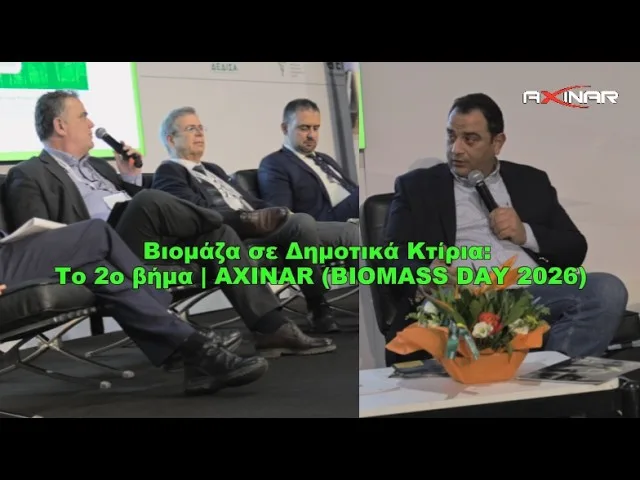
The next big step for biomass in Greece isn’t a new law or a new EU grant. It’s something far more tangible: systematic adoption in public buildings, schools, theaters, town halls, swimming pools. At BIOMASS DAY 2026, organized by ELEABIOM (the Hellenic Biomass Association) and attended by AXINAR as a member, the message was clear: the potential is there, the demand is there, what’s missing is a functional supply chain.
BIOMASS DAY 2026 and the role of ELEABIOM
BIOMASS DAY is the main annual industry event for biomass in Greece, organized by the Hellenic Biomass Association (ELEABIOM). It brings together local government representatives, industrial operators, research institutions, and equipment suppliers to discuss the rational use of biomass nationwide.
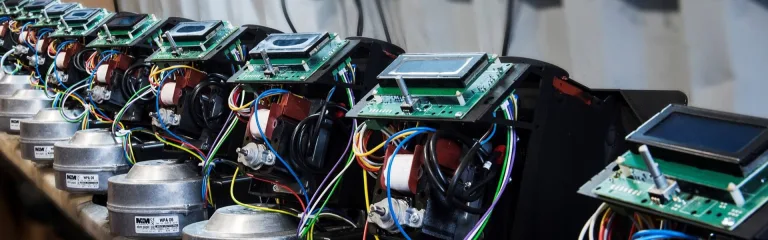
AXINAR is an active member of ELEABIOM and applies in daily practice what the dialogue addresses, designing and manufacturing biomass boilers for residential, commercial, and industrial use.
“Organized biomass management is not just an environmental policy issue, it’s a particularly important civil-protection tool.”
Representative of ELEABIOM, BIOMASS DAY 2026
Why public buildings are the next step
In private households, the heating market has already shifted to heat pumps with rooftop PV and batteries. Annual heating spend has dropped to a point where biomass no longer offers a meaningful financial advantage to a single household. In public buildings, schools, theaters, swimming pools, town halls, the picture is entirely different:
- Much higher annual consumption (a household spends ~€400/year, a municipality hundreds of thousands)
- Immediate benefit on switch, no waiting on EU grants, legislative changes, or bank financing
- ROI within 2-3 years, the investment pays back fast
- One decision point (the municipality), not thousands of private owners
“In a municipality whose oil-based heating bill reaches €800,000 per year, switching to biomass can bring it down to €500,000. The benefit is immediate. It doesn’t depend on an EU program or a change in law. A municipality can see results by the second or third year, the investment pays back.”
Municipal advisor on a district-heating biomass installation
Greece’s untapped biomass potential
Greece has enormous untapped biomass potential that today remains either dormant or, worse, burns uncontrollably in fields and forests:
- Forestry residues, byproducts of cleanings and thinning
- Urban prunings, from municipalities, private owners, network maintenance
- Agricultural and livestock biomass, crop residues, manure, processing byproducts
Tapping these sources isn’t just energy policy. It’s simultaneously a civil-protection tool, the more forestry and agricultural residue that flows into the biomass chain, the lower the wildfire risk in summer.
The market gap, why the supply chain is missing
Despite the potential, the Greek biomass market operates without a real supply chain. That means:
- There is no systematic collection of available sources
- There is no organized transport from origin to point of use
- There is no sufficient storage ensuring steady flow
- There is no institutional framework defining who does what
As long as this chain remains broken, a public building that wants to switch to biomass has no reliable fuel supplier. That, not the technology, is the real bottleneck.
Two real-world examples
Austria, a €10M district-heating plant
In Austria, a Greek industry delegation visited a town hall where the mayor described a district-heating biomass plant costing roughly €10 million. The distribution network is the bulk of the cost, but once it’s in place, switching from any fuel to biomass is a retrofit job in the boiler room.
Volos, the 5-kilometer paradox
Just south of Volos, a cement plant needs 500 tons of biomass per day to cover part of its thermal demand. A few kilometers away, in the fields, uncontrolled fires burn agricultural residue. Initial efforts are underway through cooperatives for pruning waste and through private owners for urban residue, but the real next step is an institutional framework that bridges the two sides.
“I drive past the fields and see fires burning. And I think: this is going up into the atmosphere right now, and at the same time my job is to source the same biomass to feed 500 tons a day. These two worlds, only 5 kilometers apart, can’t be matched up.”
Industry representative of a cement plant near Volos
What it takes to move from theory to implementation
Four concrete requirements emerged from BIOMASS DAY 2026:
- Institutional framework, defining mandatory use of agricultural/livestock biomass in existing facilities
- Funding tools, not only EU grants but schemes with fast absorption and clear criteria
- Authoritative scientific board providing reliable guidance to municipalities and businesses
- Partnerships with cooperatives, private owners, and industry to fill the supply chain
According to the speakers, partnerships and the patience for projects to mature are the most critical of these. The technology is already mature, execution is the open issue.
AXINAR’s role
AXINAR participates in ELEABIOM and manufactures biomass equipment at our facility in the Oreokastro Industrial Park, Thessaloniki, Greece. Our portfolio covers the full application range:
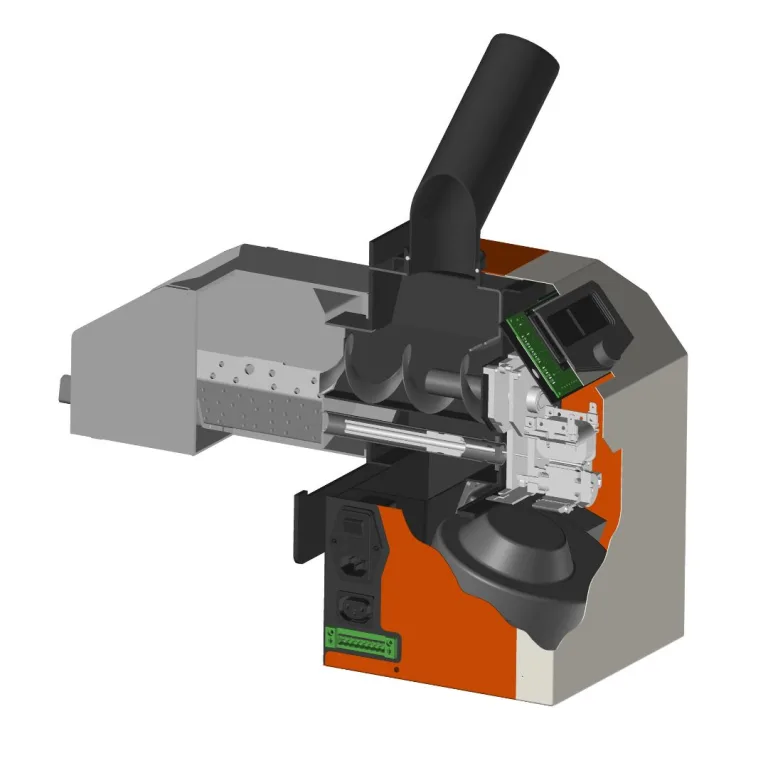
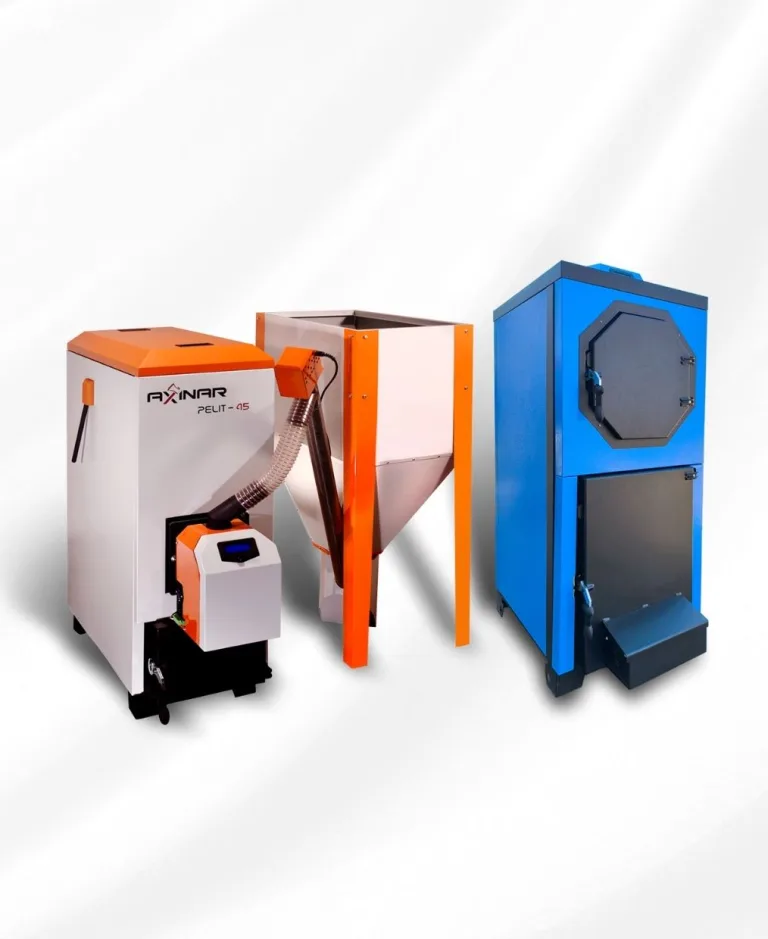
- Pellet boilers for residential and commercial use, with auto-feed and control system
- Wood-log boilers for sites with locally available biomass, see wood-boiler FAQ
- Pyrolino, a pyrolysis-based system for heat production with low emissions
- Custom design and adaptation for municipal and industrial projects, with engagement during the design phase
For a public building beginning the transition, AXINAR can join in the requirements study (thermal demand, siting, fuel supply) and propose the right configuration.
Frequently Asked Questions
What is BIOMASS DAY and ELEABIOM?
+
ELEABIOM (the Hellenic Biomass Association) is the official industry body for biomass in Greece. BIOMASS DAY is its flagship annual event, bringing together local-government, industry, research, and equipment-supplier representatives to discuss the sector’s trajectory.
What biomass sources can be used for energy?
+
Three main categories: (a) forestry residues from cleanings and thinning, (b) urban prunings from municipalities and private owners, (c) agricultural and livestock biomass (crop residues, manure). All are standardized into pellets, briquettes, or woodchips and burned in biomass boilers.
Why should a municipality choose biomass over oil?
+
Three reasons: lower fuel cost (the indicative drop from €800,000 to €500,000 per year was cited at BIOMASS DAY), energy autonomy from international oil-price swings, and reduced carbon footprint in line with Green Deal targets.
How fast does a biomass installation pay back in a public building?
+
Based on the experience shared at BIOMASS DAY, a municipality can see tangible results in the second or third year of operation, with the investment paying back without depending on EU grants or bank financing. The exact timing depends on installation size and the price of the alternative fuel.
What does AXINAR offer for public-building projects?
+
AXINAR manufactures pellet boilers, wood-log boilers, and the Pyrolino system for residential, commercial, and industrial use. For municipal projects we participate in the requirements study (thermal demand, fuel storage, siting) and tailor the configuration. Call +30 2310 808 159 to discuss your project.
What is the biochar that came up at BIOMASS DAY?
+
Biochar is a charcoal-like product made by heating biomass (such as wood) in the absence of oxygen through pyrolysis. It is used as soil amendment, for carbon sequestration, and as an energy source, a circular-economy example within the biomass field.
REQUEST A QUOTE
Municipality or industry? Let’s move from theory to implementation.
We design and manufacture biomass boilers for public buildings, industrial sites, and commercial facilities. Send us your project data (thermal demand, installation site, available fuel) and we’ll respond with a detailed proposal.
or email sales@axinar.com