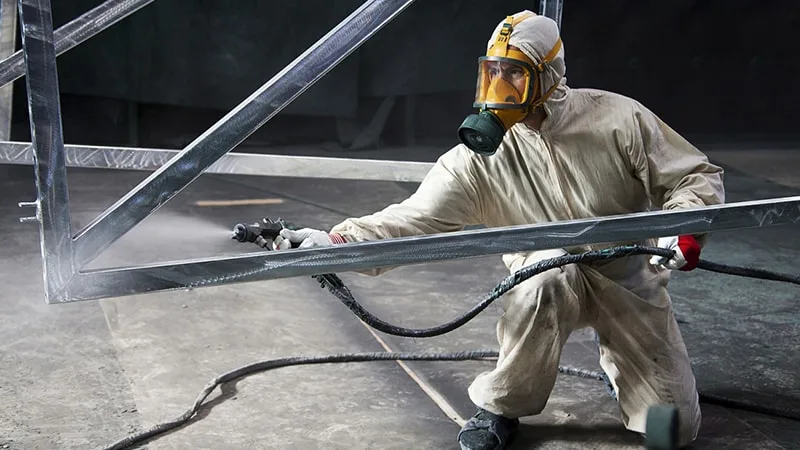
Electrostatic metal painting (powder coating) is the most widely used industrial metal finishing method worldwide. Instead of wet paint and solvents, it uses dry powder that adheres to metal through an electrostatic charge and is then cured in an oven, creating a coating that far surpasses traditional paints in durability, uniformity and service life.
At Axinar, electrostatic painting is carried out with an automated GEMA system on a 120-metre production line, capable of coating parts up to 6.5 metres in length. Our facility is located in Thessaloniki, Greece and operates under ISO 9001:2015 and ISO 14001:2015 certifications.
How electrostatic painting works
The principle is simple but effective: an electrostatic gun negatively charges the powder particles, which are attracted to and adhere uniformly to the grounded metal surface. The part then enters a polymerisation oven at 180–200°C for 15–20 minutes, where the powder melts, flows and hardens into a solid film with a thickness of 60–120 μm.
The result is a surface free of drips, bubbles or inconsistencies, something wet painting cannot guarantee with the same consistency.
The 4 stages of the process
1. Sandblasting & chemical pre-treatment
The metal is cleaned of oxides, oils and impurities. Sandblasting creates micro-roughness for better adhesion, while phosphating (or zirconiation for aluminium) forms a protective layer against corrosion. Without proper pre-treatment, even the best coating will fail.
2. Powder application
The automated GEMA system applies the powder with precision, ensuring uniform thickness across the entire surface, even on complex geometries, corners and recesses. Powder that does not adhere is recycled and reused.
3. Oven curing
The polymerisation oven transforms the powder into a continuous, hard film. Temperature and time are automatically controlled per powder type, polyester, epoxy or hybrid, for optimal results.
4. Cooling & quality control
After curing, parts are gradually cooled. Every batch is checked with a film thickness gauge and visual inspection before delivery to the customer.
Why electrostatic painting outperforms wet painting
| Feature | Electrostatic (Powder Coating) | Wet paint |
|---|---|---|
| Coating thickness | 60–120 μm in a single pass | 20–40 μm (requires multiple coats) |
| Corrosion resistance | 15–25+ years | 5–10 years |
| VOC emissions | Zero | High (solvents) |
| Material efficiency | 95–98% (powder recycling) | 40–60% (overspray waste) |
| UV resistance | Excellent (polyester powder) | Moderate (yellowing over time) |
| Drips / bubbles | None | Common issue |
Textures & finishes
Electrostatic painting is not limited to smooth surfaces. At Axinar we offer:
- Smooth, classic, clean appearance
- Textured (Shagreen), rough finish that conceals imperfections
- Matte, modern aesthetic without reflections
- Gloss, high shine, ideal for decorative elements
- Semi-gloss, balance between shine and subtlety
- Metallic / Anodised effect, aluminium or copper effect
Over 200 RAL colours available, as well as custom shades matched to sample.
Applications
Architecture & construction
Aluminium window frames, staircases, fencing, metal facades. Polyester powder withstands salt, rain and intense solar radiation, critical for coastal areas such as Thessaloniki and Halkidiki.
Industry & OEM
Machinery, electrical panels, storage shelving, photovoltaic mounting systems, metal cabinets. Epoxy powder provides resistance to chemicals and mechanical stress.
Furniture & interior design
Metal furniture, lighting fixtures, shelving, decorative elements. The variety of textures and colours offers unlimited design possibilities.
Automotive & motorsport
Rims, bumpers, roll bars, motorcycle components. Resistance to stone chips, heat and road salt.
What metals can be coated
- Steel (mild, galvanised, stainless)
- Aluminium (profiles, sheets, castings)
- Iron
- Zinc
- MDF (with a special pre-heating process)
Key requirement: the material must withstand temperatures of 180–200°C during curing.
The GEMA system at Axinar
Axinar has invested in an automated GEMA coating line, the world's leading manufacturer of electrostatic systems. This means:
- Automatic thickness and uniformity adjustment
- Real-time powder recycling
- Rapid colour changes without production downtime
- Coating of parts up to 6.5 metres in length
- Production capacity for large batches and OEM partnerships
Frequently asked questions
How much does electrostatic painting cost?
The cost depends on the size, geometry of the part and powder type. Generally, the cost per square metre is competitive compared to wet painting, while the longer service life drastically reduces total cost of ownership. Request a quote for an exact price.
How long does electrostatic painting last outdoors?
With polyester powder suitable for outdoor use, the coating lasts 15–25 years without peeling, yellowing or colour loss. In industrial environments, epoxy powder offers even greater chemical resistance.
Can an electrostatically coated part be repainted?
Yes. Light sandblasting to create adhesion is sufficient and a new layer of powder is applied as normal. Removal of the old film is not necessary unless there is extensive damage.
Is it environmentally friendly?
Absolutely. Zero volatile organic compound (VOC) emissions, recycling of excess powder and no solvents used. Electrostatic painting is the most eco-friendly method of metal coating available.
Electrostatic painting at Axinar, Thessaloniki
With 18+ years of experience in metal processing, Axinar offers complete electrostatic painting services for professionals and industries throughout Greece and Europe. From individual parts to mass OEM production, every project comes with a quality guarantee and technical support.
Contact us for a free quote or send your parts for a trial coating.