Selecting the right PV mounting system is the first technical question of every installation. The answer depends on roof type, inclined tile roof, industrial metal roof, or flat roof, and solutions differ significantly between them. In practice, wrong selection means either double the cost, or roof waterproofing problems in 3–5 years.
Tile Roof (Inclined Roof with Tiles)
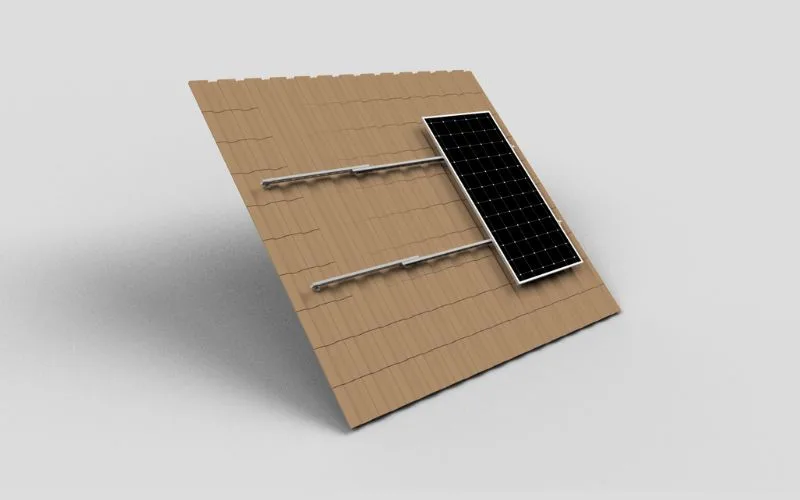
The most common residential roof type in Greece. The main issue here is fixing without damaging tile waterproofing. The basic technique is fixing to standard wooden rafters with special anchors that “pass” between the tiles.
AXINAR Tile Roof System
Special system with roof hooks that fix to tiles without perforation. Hooks come down to the rafter and support horizontal rails where PVs are screwed. Base version uses:
- Steel: S320GD galvanized (25+ years durability)
- Roof hooks: Adjustable for various tile profiles (Roman, Marseille, Byzantine)
- Rails: Anodized aluminum or galvanized steel
- Advantage: Minimal roof perforation, zero leak risk
Industrial Metal Roof (Sheet Panels)
Industrial roofs from trapezoidal sheet or sandwich panels have different techniques. Instead of hooks, clamps or industrial screws are used that fix directly to the ridged points of the sheet:
- Threaded rods: Special screws pulling the panel onto the ridge
- Standing Seam Clamps: For standing seam roofs, no perforation
- Bolted / Hook: Combination for specific geometries
AXINAR provides Axisol R (Industrial Roof) for these applications, S320GD steel, 25+ years galvanic durability, proven in industrial installations.
Flat Roof
Flat roof is seemingly easier, no tiles to worry about, but has its own rules. Two main approaches:
1. Ballast (No Perforation)
The mount is supported with concrete or granite weights, no hole in the waterproofing membrane. AXINAR DuckStand and East West are low-profile ballasted systems in S320GD steel:
- No perforation: Doesn’t touch waterproofing
- Ballast loading: Weight holds the system (typically 100–150 kg/kW)
- Installation speed: Very fast, modular elements
- Ideal for: New homes, commercial buildings with membrane
2. Bolted to Concrete
If the flat roof is bare concrete (no membrane) or perforation is fine, we can use Terrasol 1V or Terrasol 2V:
- Terrasol 1V: One row of panels per rail, for common orientations (south) with larger tilt
- Terrasol 2V: Two rows of panels per rail, compact design for maximum density on small roofs
- Material: Galvanized steel, Greek manufacture
- Adjustable tilt: Allows adjustment to optimal angle for the area
Selection Table
| Roof Type | AXINAR System | Advantages |
|---|---|---|
| Tile Roof | Tile Roof | Zero perforation, adjustable hooks |
| Industrial Metal | Axisol R – Industrial Roof | Threaded rods, clamps, S320GD |
| Flat Roof (with membrane) | DuckStand or East West (ballast) | No perforation, fast |
| Flat Roof (bare concrete) | Terrasol 1V or 2V | Adjustable tilt, bolted |
Selection Criteria
- Waterproofing: If roof has membrane or older construction, prefer ballasted (zero perforation)
- Available space: Terrasol 2V (2 rows) gives greater power density per roof sqm
- Wind zone: Ballasted systems need extra weight in high wind pressure zones (islands, coastal)
- Roof load: Check if roof can bear the extra weight (typically 15–25 kg/m² with ballast, 5–10 kg/m² bolted)
- Static study: AXINAR provides free static study for every project
Ideal for roofs with waterproofing membrane. Ballast system ensures stability without touching roof waterproofing.
- Galvanized S320GD steel
- Ballast loading, no holes
- Modular design for fast installation
For roofs where you want maximum power per square meter. The 2-row arrangement uses space better.
- Galvanized Greek manufacture
- Compact, maximum power density
- Adjustable tilt
Request a Static Study & Quote
Send us your project basics, square meters, roof or ground type, zone, PV capacity, and we’ll respond within 24 hours with a recommended mounting system and free static study.
See PV tilt angle in Greece or all AXINAR mounts.