If you are planning a metal fabrication project, whether it is industrial equipment, a stainless steel tank or a simple railing, the choice of welding method determines the strength, appearance and cost of the final product. The three dominant methods in industry today are MIG, TIG and MMA (stick welding). In this guide we explain how each one works, where it excels and how to choose the right method for your project.
What do the abbreviations MIG, TIG, MMA mean
- MIG (Metal Inert Gas), also known as GMAW. Uses continuous wire as electrode and shielding gas (typically argon + CO₂).
- TIG (Tungsten Inert Gas), also known as GTAW. Uses a non-consumable tungsten electrode and a separate filler rod.
- MMA (Manual Metal Arc), also known as SMAW or stick welding. Uses a consumable electrode with flux coating that creates protective slag.
How each method works
MIG: Speed and productivity
The welder holds a gun that automatically feeds wire electrode. Simultaneously, shielding gas flows to isolate the weld pool from atmospheric air. The rapid wire feed means a high deposition rate, ideal for long weld runs on steel and aluminium.
Thickness range: 0.8 mm to 25+ mm (depending on the machine). At Axinar we use MIG for thicknesses of 0.4–25 mm.
TIG: Precision and aesthetics
The welder simultaneously controls the arc (via the tungsten electrode) and filler material addition (manual rod). This requires significant skill but allows exceptional heat control, critical for thin walls, stainless steel and aluminium where overheating causes distortion.
Thickness range: 0.5 mm to 16 mm. At Axinar we use TIG for thicknesses of 0.5–16 mm, primarily on stainless steel and aluminium.
MMA (Stick Welding): Simplicity and field resilience
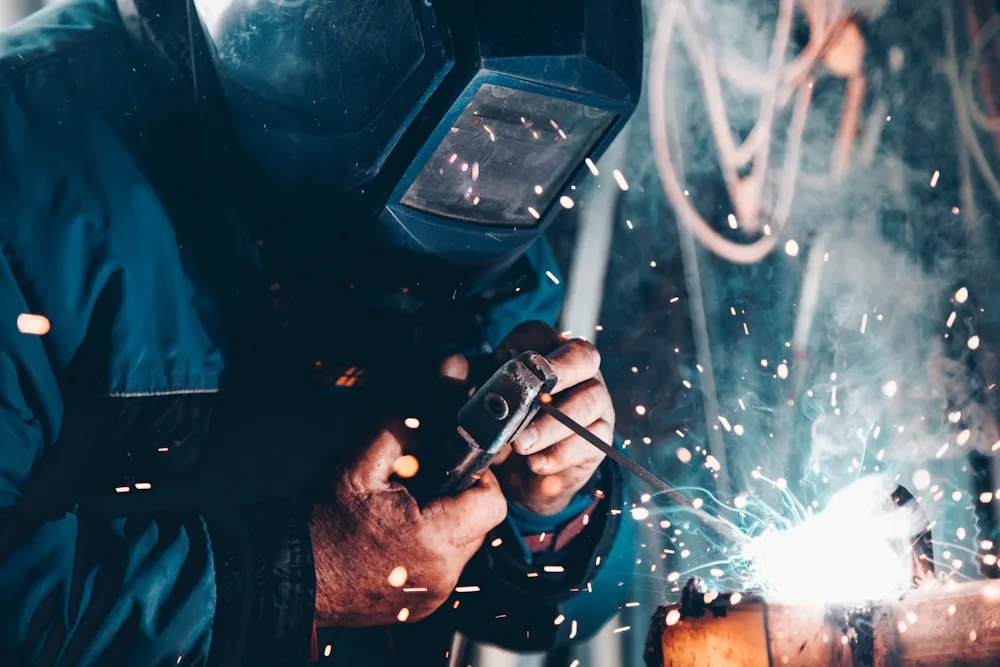
The oldest and most widespread method. The electrode melts together with its flux coating, creating protective slag over the weld bead. No external shielding gas is required, so it works even outdoors in windy conditions. Ideal for field work, repairs and heavy structural welding.
Thickness range: 2 mm and above. Not recommended for thin sheet metal.
MIG vs TIG vs MMA: Full comparison
| Feature | MIG | TIG | MMA |
|---|---|---|---|
| Speed | High | Low | Medium |
| Weld quality | Good | Excellent | Moderate |
| Aesthetic finish | Good | Excellent (clean bead) | Requires slag removal |
| Minimum thickness | 0.4 mm | 0.5 mm | 2 mm |
| Maximum thickness | 25+ mm | 16 mm | Unlimited (multiple passes) |
| Carbon steel | Excellent | Very good | Very good |
| Stainless steel (Inox) | Good | Excellent | Moderate |
| Aluminium | Good (with pulse) | Excellent | Not recommended |
| Shielding gas required | Yes (Ar/CO₂) | Yes (Argon) | No |
| Outdoor use | Limited (wind disperses gas) | Limited | Excellent |
| Skill required | Medium | High | Low |
| Equipment cost | Medium | High | Low |
| Cost per metre of weld | Low (fast) | High (slow) | Medium |
| Automation | Easy (robotic MIG) | Possible (orbital TIG) | Not automatable |
When to choose MIG
- Long weld runs on steel or aluminium
- High-volume production (serial production, OEM)
- Thicknesses from 0.4 mm to 25+ mm
- When speed and cost are the priority
- Metal structures, PV mounting systems, shelving, machine frames
When to choose TIG
- Stainless steel (inox), food industry, pharmaceutical, chemical industry
- Aluminium, lightweight structures, aerospace
- Thin walls (0.5–3 mm) where distortion must be minimal
- When weld bead aesthetics are critical (visible welds, decorative work)
- High-pressure piping, tanks, precision components
When to choose MMA (Stick Welding)
- Work on construction sites or outdoors (no gas required)
- Repair of existing structures
- Heavy structural work, beams, columns, foundations
- Thicknesses above 3 mm
- When equipment needs to be portable and simple
The fourth option: Laser Welding
Beyond the three traditional methods, there is also laser welding, a technology that is rapidly gaining ground in industry. It uses a concentrated laser beam to fuse the metal, offering:
- Minimal thermal distortion, the heat-affected zone (HAZ) is much smaller
- Exceptional speed, faster than TIG with comparable quality
- Clean weld bead with little or no post-processing required
- Ability to weld very thin materials (from 0.2 mm)
At Axinar we operate a 3KW laser welding system, something very few companies in Greece offer. Ideal for stainless steel, thin sheet metal and applications where distortion is not acceptable.
After welding: Finishing and protection
Welding is only one step in the fabrication process. After the weld, the part typically requires:
- Deburring, removal of burrs and impurities for a clean surface
- Electrostatic painting (powder coating) for corrosion protection and aesthetics
- Hot-dip galvanising for long-term protection on outdoor structures
Frequently asked questions
Which welding method is strongest?
All three methods (MIG, TIG, MMA) produce structurally strong welds when executed correctly. Strength depends more on joint preparation, welding parameters and welder experience than on the method itself. TIG tends to produce the most uniform beads with no inclusions.
Which method is cheapest?
MIG has the lowest cost per metre of weld thanks to its high deposition rate. MMA has the cheapest equipment but is slower. TIG is the most expensive in labour time but saves on post-weld finishing costs.
Can I weld aluminium with MIG?
Yes, using pulse MIG and aluminium wire (e.g. AlMg5). However, for thin walls and high aesthetic requirements, TIG remains the preferred method for aluminium.
Why is TIG more expensive?
TIG is a manual process that requires high skill and is performed at a lower speed. Labour time per metre of weld is 3–5 times higher than MIG. This is offset by the superior quality and savings on post-weld finishing.
What does "stick welding" mean?
"Stick welding" refers to the MMA (Manual Metal Arc) method. The consumable electrodes are metal rods with a flux coating. The coating burns during welding and creates shielding gas and slag over the weld bead.
Which method does Axinar use?
At our factory in Thessaloniki we have all three methods plus laser welding:
- MIG, for serial production, metal structures, PV mounting systems (thicknesses 0.4–25 mm)
- TIG, for stainless steel, aluminium, thin sheet metal, precision applications (thicknesses 0.5–16 mm)
- Laser 3KW, for minimal distortion, high speed and clean finish
The method is selected in collaboration with the client, based on the material, thickness, and strength and aesthetic requirements. Every project follows ISO 9001:2015 certified procedures.
Contact us to help you choose the right welding method for your project.