Zinc is the most well-established protection system for steel against corrosion. However, it can be applied through two very different methods, hot-dip galvanizing (immersion in molten zinc) and cold galvanizing (applying zinc in paint form). The difference in real-world durability is significant, and often overlooked.
Hot-Dip Galvanizing
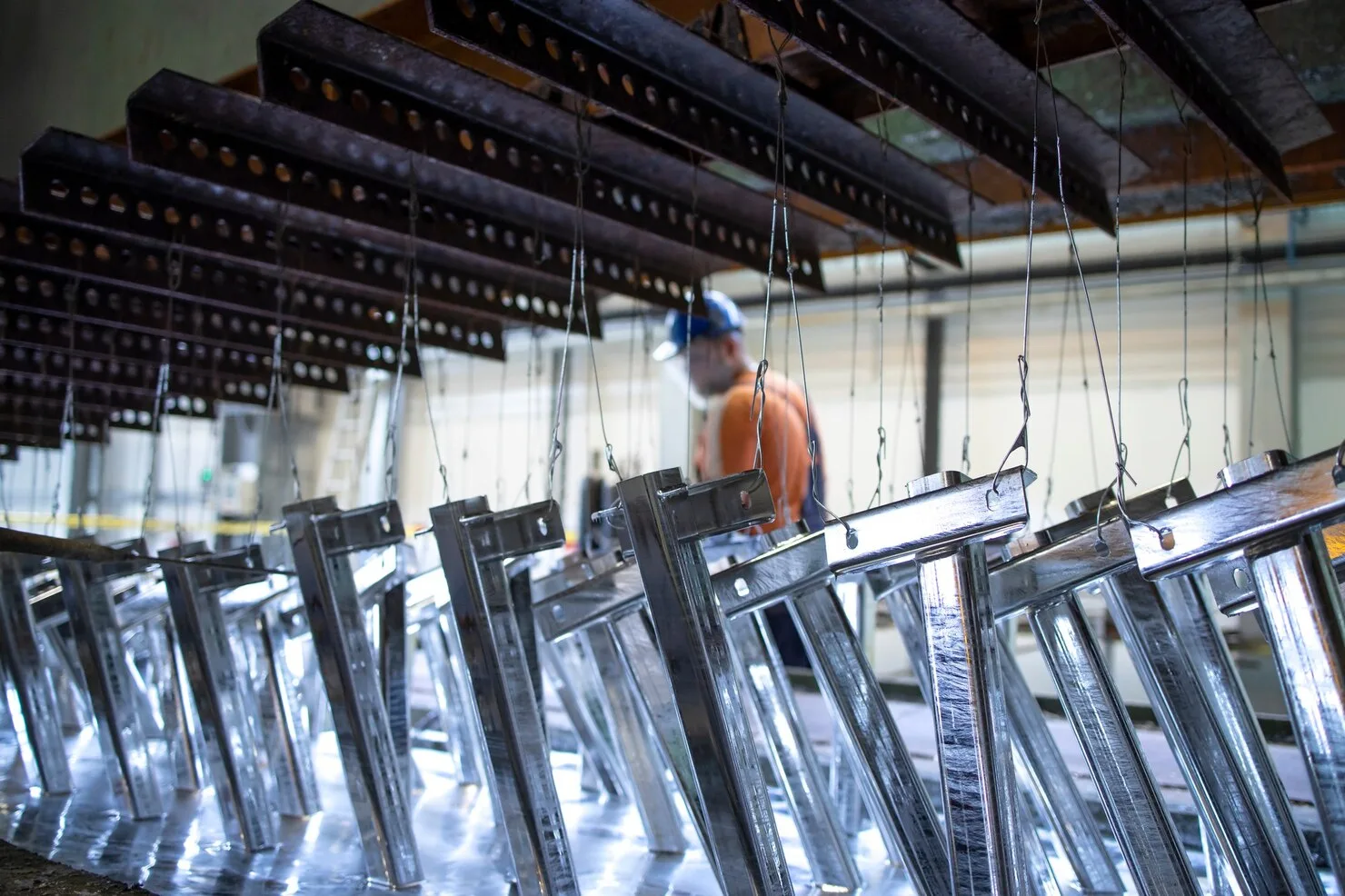
Steel is immersed in molten zinc at 440–460°C (typical values, up to 560°C for special processes). The zinc reacts chemically with the iron, creating an integrated Zn-Fe alloy layer on the surface. Above that lies an outer layer of pure zinc that completes the protection.
- Coating thickness: 55–150 μm depending on steel thickness, per EN ISO 1461
- Durability: 25–100 years depending on environmental corrosivity
- Chemical bond: yes, Zn-Fe alloy, does not detach
- Sacrificial protection: yes, even if the zinc is scratched, it protects the surrounding metal
- Certification: EN ISO 1461 (minimum thicknesses, salt spray testing)
What Actually Happens in the Bath
Pure zinc melts at ~419°C. The galvanizing bath is kept slightly above this to remain liquid and allow proper reaction. The bath zinc must have a purity of at least 98.5% (per ASTM B6 and EN 1179) to produce a consistent coating without foreign metal inclusions.
Steel pre-treatment happens in a hydrochloric acid (HCl) solution to remove oxides, rust, greases and corrosion products that would prevent chemical bonding. This is followed by fluxing with ZnCl₂ to activate the surface, and only then is the part lowered into the molten zinc.
A particularly useful characteristic of the method: zinc concentrates naturally at corners and edges, exactly where paint would be thinner and where corrosion would start first. This is a unique advantage of hot-dip galvanizing over organic coatings.
Dry Coating Without Cure Time
Often overlooked: once the part exits the bath and cools, the coating is already dry and hard. There is no “curing time” like with paint (which often needs a week between coats). The galvanized part can be assembled immediately.
Cold Galvanizing (Zinc-Rich Paint)
This is paint with a high zinc content (typically 80–96% Zn in the dry film). It’s applied with brush, roller, or spray, on a clean dry surface. Protection is mechanical coverage, no chemical bond with the metal.
- Coating thickness: 40–80 μm per coat, with 2–3 coats for adequate protection
- Durability: 3–10 years in outdoor exposure (typical)
- Chemical bond: no, can peel or detach over time
- Sacrificial protection: partial, the Zn in the paint acts as an anode but with limited duration
- Certification: variable, not covered by EN ISO 1461
Comparison Table
| Hot-Dip Galvanizing | Cold Galvanizing | |
|---|---|---|
| Application method | Immersion in molten Zn | Paint (brush, roller, spray) |
| Coating thickness | 55–150 μm | 40–80 μm per coat |
| Durability | 25–100 years | 3–10 years |
| Chemical bond with metal | Yes (Zn-Fe alloy) | No |
| Sacrificial protection | Yes, full | Partial |
| Scratch repair | Self-repair via Zn | Requires re-painting |
| Field application | No, factory only | Yes, technician on-site |
| Cost per year of durability | Very low | High |
| Certification | EN ISO 1461 | No standardized |
When to Use Each
Hot-Dip Galvanizing, Use When:
- You need 25+ years corrosion durability without maintenance
- The product is permanently exposed to outdoor environment (PV mounts, structural, canopies)
- Must comply with EN ISO 1461 specifications (public works, large projects)
- Geometry is complex (corners, internal surfaces) where paint hardly reaches
Cold Galvanizing, Use When:
- Repairing local damage on an already hot-dip galvanized structure (scratch, on-site welding)
- The piece is too large for the galvanizing tank
- No hot-dip galvanizing infrastructure is available at the location
- Temporary protection until final processing
Real-World Applications of Hot-Dip Galvanized Steel
Hot-dip galvanizing is the dominant protection method in long-lifespan infrastructure projects. Typical applications:
- Road infrastructure: Safety guardrails, lighting poles, traffic signals, road signs
- Energy: High-voltage pylons, photovoltaic bases (PV mounts), wind turbines
- Shipbuilding & marine equipment: Components exposed to salt environment (Magnelis is a specialized variant)
- Structural construction: Bridges, external staircases, canopies, industrial building frames
- Small mass-production items: Screws, nails, hinges, components resistant to outdoor exposure
- Agricultural & farm installations: Greenhouses, agri-PV supports, mesh, animal shelters
The “Zero Maintenance” Logic
The economic difference vs. simple paint lies in maintenance cost. Standard steel paint requires touch-ups or repainting every 10–20 years, while hot-dip galvanizing on a properly installed structure requires no maintenance. For long-lifespan structures (public infrastructure, PV mounts) this difference translates into significantly lower lifecycle cost.
AXINAR provides hot-dip galvanizing per EN ISO 1461 for its own PV mounts and for OEM customers.
- Full cycle: cleaning, fluxing, immersion
- Coating thickness 85μm and above
- EN ISO 1461 certified
Request a Quote for Your Project
Send us sketches, CAD drawings, or a description of your project, and we’ll respond within 24 hours with a technical estimate. We cover everything from prototypes to mass OEM production.
See also the comparison of galvanized vs aluminum vs inox, or all AXINAR metal processes.