Selecting material for an outdoor metal structure is not simple. The same question, “galvanized, aluminum, or inox?”, has a different correct answer for a PV mount, a parking canopy, a water tank, or a heat exchanger. Behind the choice lie compromises between cost, weight, durability and technical constraints.
Galvanized Steel (Hot-Dip)
The most economical and proven for outdoor structural work.
- Corrosion resistance: 25–75 years with 85+ μm Zn thickness (EN ISO 1461)
- Mechanical strength: Very high, S235/S355 steel
- Weight: Density 7.85 g/cm³, heavy
- Raw material cost: Low (steel) + galvanizing processing (~15–25% extra)
- Repairability: Easy (welding + local cold galvanizing)
- Limitations: Coastal zones (C5-M) significantly reduce durability
Aluminum (Al Alloys 6082, 6061, 5083)
Lightweight, corrosion-resistant, ideal where weight matters.
- Corrosion resistance: Excellent, self-passivates with thin Al₂O₃ layer
- Mechanical strength: Medium, 60–70% lower than steel at similar thickness
- Weight: 2.70 g/cm³, 1/3 of steel
- Raw material cost: 3–5x higher than galvanized steel per kg
- Repairability: Weldable (TIG, MIG with special wire) but loses strength in HAZ
- Limitations: Galvanic corrosion when in contact with steel in wet environment
Inox / Stainless Steel (304, 316L)
The “premium” choice, maximum resistance but also maximum cost.
- Corrosion resistance: Excellent, 304 for general use, 316L for marine/chemical
- Mechanical strength: High, similar or better than plain steel
- Weight: 7.90 g/cm³, similar to steel
- Raw material cost: 5–10x higher than galvanized steel
- Repairability: Excellent, TIG welding maintains corrosion resistance
- Limitations: Sensitive to contact with rusted steel (contamination)
Comparison Table
| Characteristic | Galvanized | Aluminum | Inox 304 |
|---|---|---|---|
| Outdoor corrosion resistance | Very good | Excellent | Excellent |
| Marine corrosion resistance | Medium | Good | Very good (316L) |
| Mechanical strength | Very high | Medium | High |
| Weight | Heavy (7.85) | Light (2.70) | Heavy (7.90) |
| Raw material cost | Base: 1x | 3–5x | 5–10x |
| Maintenance-free duration | 25–75 years | 40+ years | 50+ years |
| Paintability | Yes (needs primer) | Yes | Yes |
| Welding | Easy (loses Zn in zone) | Demanding | TIG standard |
Selection Guide per Application
- PV mounts (ground/roof): Hot-dip galvanized steel, best combo of cost/durability/mechanical properties
- PV mounts in marine environment: Aluminum (Al 6082) or hot-dip galvanizing with Magnelis (ZM120)
- Domestic water tank: Inox 304 (water) or 316L (geothermal)
- Food/chemical tank: Inox 316L
- Building structural steel: Hot-dip galvanized steel
- Parking canopies: Hot-dip galvanized steel (long spans, weight)
- Balcony railings / indoor furniture: Aluminum (if weight matters) or inox (aesthetic)
Mechanical, Thermal & Electrical Properties
Beyond corrosion resistance, the three materials differ significantly in physical and mechanical properties that directly affect structural design:
| Property | Galvanized Steel | Aluminum 6061-T6 | Inox 304 |
|---|---|---|---|
| Young’s Modulus | ~200 GPa | ~69 GPa | ~193 GPa |
| Yield strength | ~250 MPa (S235) | ~276 MPa (6061-T6) | ~215 MPa |
| Melting point | ~1500°C | ~660°C | ~1400°C |
| Thermal conductivity | ~50 W/m·K | ~167 W/m·K | ~16 W/m·K |
| Strength loss at 200–300°C | Minimal | ~50% | Minimal |
Key practical consequences:
- Stiffness: Aluminum has almost 1/3 the elastic modulus of steel. An aluminum beam of the same weight will deflect more, needs larger cross-section for equal stiffness.
- Fire safety: Aluminum loses about 50% of its strength at 200–300°C. In structural applications with fire resistance requirements (e.g. canopies next to industrial units), galvanized steel is preferred.
- Heat dissipation: Aluminum conducts heat 3–10x better than steel, that’s why it’s the material of choice for heat exchangers & heat sinks.
Chemical Susceptibility & pH Window
The three methods have different “safety windows” regarding environment acidity/alkalinity:
- Aluminum: Works well in pH 4.5–8.5. Outside this range (e.g. contact with fresh concrete pH ~12), the Al₂O₃ protective layer dissolves and aluminum corrodes fast.
- Galvanized steel: More resistant to alkalis pH 7–12.5. But vulnerable to acidic conditions (marine air, SO₂ industrial emissions).
- Inox 304: Very wide window pH 1–13. 316L extends resistance to even more aggressive chemical environments.
Galvanic Corrosion: The Hidden Danger When Joining Different Metals
Many metal projects fail not because of the material itself, but because two different metals come in contact in a wet environment. A galvanic cell forms, accelerating corrosion of the “less noble” metal (anode).
Critical combinations to avoid in outdoor structures:
- Aluminum + bare steel: Aluminum becomes anode and corrodes fast (within months in wet environment)
- Aluminum + copper: Even more intense galvanic action, big potential difference
- Steel + inox: Steel becomes anode and oxidizes faster
Safer combinations:
- Galvanized steel + aluminum: Mild galvanic action (the Zn mediates)
- Aluminum + inox bolts: “Large anode” (Al sheet) with “small cathodes” (inox bolts), aluminum has enough mass to absorb galvanic action
- Dielectric gaskets: EPDM washers or nylon isolators break the electrical contact and eliminate the problem
Processing Constraints per Material
Bending
- Galvanized (pre-galvanized): Requires minimum bend radius ≥ 3× thickness to avoid Zn coating flaking in tension zone. For tighter tolerances: bend first, hot-dip galvanize after.
- Aluminum 6082-T6 / 6061-T6: Sensitive to cracks, large bend radius (2–4× thickness), attention to material rolling direction.
- Inox 304: Intense springback (5–8°), work hardening during bending.
Welding
- Galvanized: Zinc fumes during welding are dangerous (metal fume fever). Local ventilation required. After welding, local Zn restoration is needed (cold galvanizing or spray).
- Aluminum: The heat-affected zone (HAZ) softens by 40–50%. For critical applications, Friction Stir Welding (FSW) is used.
- Inox: Welds well with TIG without significant strength loss, but sensitive to contamination with rust.
Recycling & End-of-Life Economic Value
- Aluminum: Requires only 5% of the energy for recycling compared to primary production. Residual scrap value is 30–45% of new metal price, significant factor for long-term installations (e.g. 25-year PV mounts).
- Galvanized steel: Lower residual value. Zn coating complicates recycling (needs separate Zn handling before melting).
- Inox 304/316L: High scrap value, Ni & Cr retain economic value.
Special Variants: Zn-Al-Mg (Magnelis®)
A middle option gaining ground: zinc-aluminum-magnesium coating (Zn-Al-Mg), commercially known as Magnelis®. In salt spray tests, it shows 10–20x greater corrosion resistance than plain galvanized steel, at similar cost. It’s AXINAR’s choice for East-West agri-PV and ground mount PV in coastal/agricultural environments where plain hot-dip galvanizing isn’t sufficient.
AXINAR works with all materials. Based on your project, we recommend the most economical solution without compromising duration.
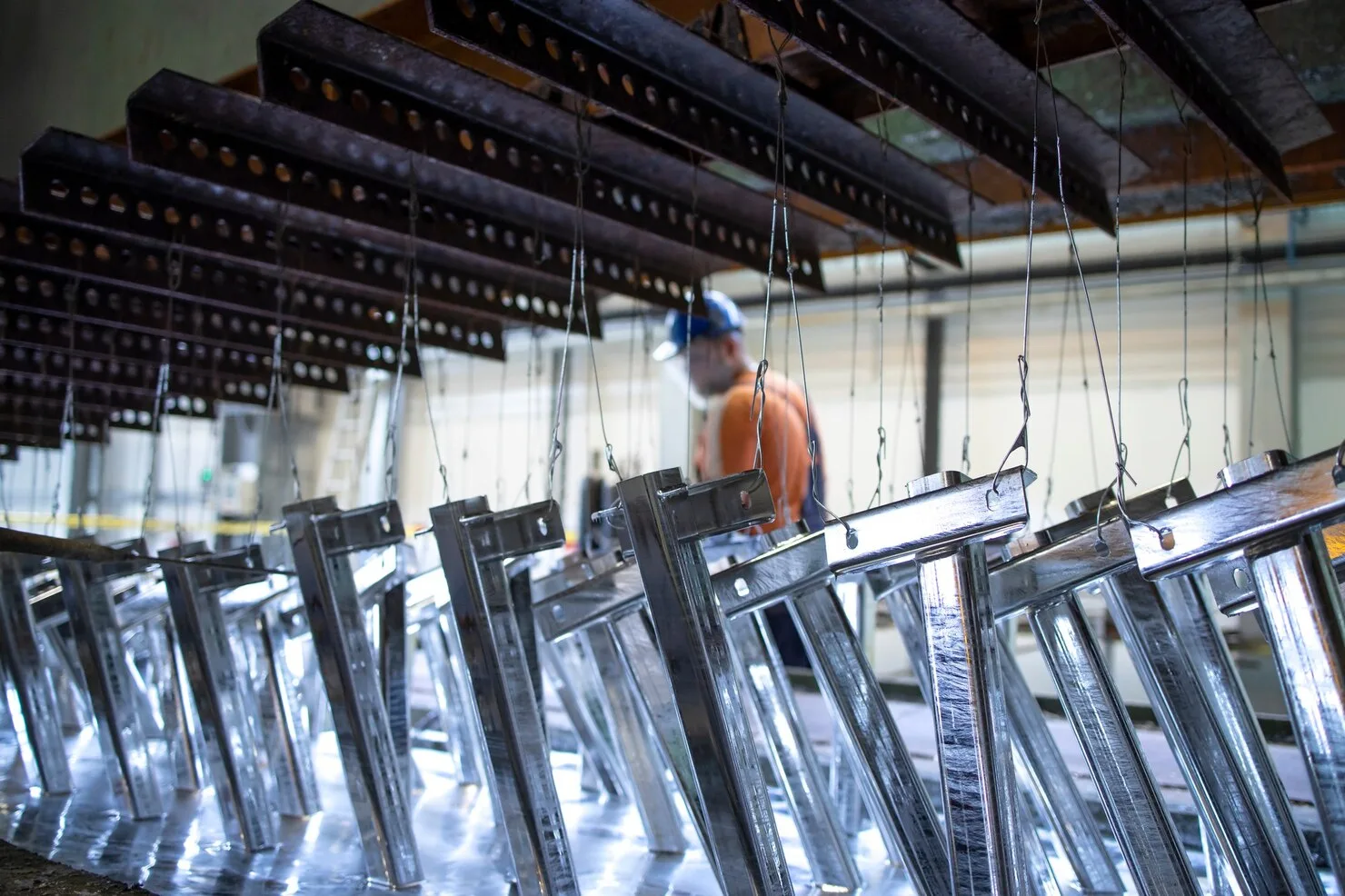
- Hot-dip galvanizing EN ISO 1461
- Inox processing with laser welding
- Aluminum Al 6082 sheet bending
Request a Quote for Your Project
Send us sketches, CAD drawings, or a description of your project, and we’ll respond within 24 hours with a technical estimate. We cover everything from prototypes to mass OEM production.
See also hot-dip vs cold galvanizing comparison or all AXINAR processes.