Boiler Power per Square Meter: Complete Sizing Guide (2026)
Which is the best wood boiler? Which is the best pellet boiler? And which is the most economical biomass boiler? These are among the most common questions we receive at our technical support.
The honest answer: there is no single “best” or “most economical” boiler that fits everyone. Each installation has its own characteristics, floor area, building insulation, climate zone, domestic hot water requirements, radiator type, ceiling height, and budget. A 30 kW boiler that is ideal for a 150 m² home in Athens with good insulation will be undersized in an identical 150 m² home in northern Greece with old windows.
The right boiler is the one that fits your need.
The following guide shows how to select the correct power per square meter, with cost tables and specific Axinar pellet and wood boiler models from 20 to 250 kW.
- 100 m² → 12-18 kW
- 120 m² → 15-22 kW
- 150 m² → 18-27 kW
- 200 m² → 25-36 kW
- 300 m² → 36-54 kW
Actual values depend on insulation, zone, ceiling height, and domestic hot water needs.
How to Calculate Boiler Power
The basic calculation formula is:
Power (kW) = Area (m²) × Coefficient (kW/m²)
The coefficient depends on two main factors: building insulation and climate zone.
Insulation coefficients
| Building type | kW / m² |
|---|---|
| New construction, energy class A+ (KENAK) | 0.08 – 0.10 |
| Well insulated, energy class B | 0.10 – 0.13 |
| Medium insulation (homes built 1990-2010) | 0.13 – 0.17 |
| Old construction, no insulation | 0.18 – 0.25 |
Greek climate zones
| Zone | Regions | × |
|---|---|---|
| A (southernmost) | Crete, Rhodes, Aegean islands, Laconia | 0.85 |
| B | Attica, Peloponnese, S. Epirus | 1.00 |
| C | Thessaloniki, Central Macedonia, Thessaly | 1.10 |
| D (northernmost) | W. Macedonia, mountainous Epirus, Drama, Evros | 1.25 |
Sample calculation
Home 150 m², medium insulation, Thessaloniki (Zone C):
- Base power: 150 × 0.15 = 22.5 kW
- With zone C: 22.5 × 1.10 = ~25 kW
Recommended models: Axinar PELIT PL30 (30 kW), 1.944,80€ or Axinar BM30 Wood (30 kW), 2.387€.
Pellet Boilers, Selection Table
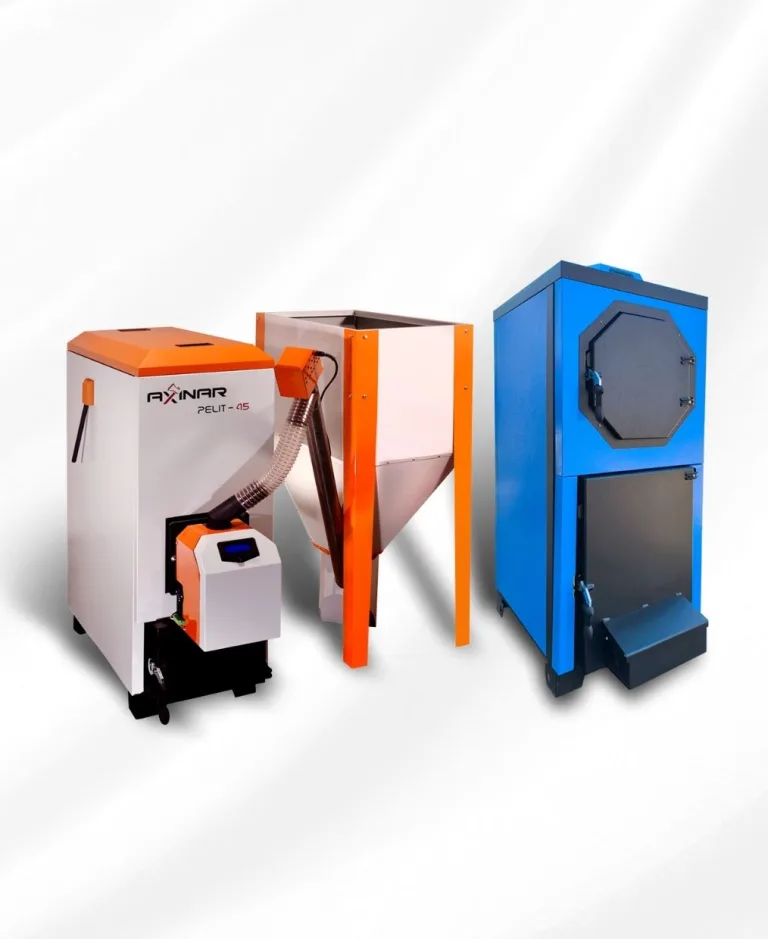
Pellet boilers have stable efficiency of 90-93%, so theoretical power translates to actual heating. Axinar produces three lines:
- PELIT: base boiler (burner sold separately)
- PelletWork (PW): integrated system with built-in burner
- CALOS: all-in-one with automatic cleaning, ideal for small installations
| Area | Power | PELIT (base) | PelletWork (integrated) |
|---|---|---|---|
| 60-100 m² | 8-20 kW |
CL8–32
4.016,10€
|
PW20
2.932,60€
|
| 100-150 m² | 20-30 kW |
PL20
1.882,10€
|
PW20
2.932,60€
|
| 150-220 m² | 30-45 kW |
PL30
1.944,80€
|
PW30
3.137,20€
|
| 220-330 m² | 45-75 kW |
PL45
2.148,30€
|
PW45
3.546,40€
|
| 330-500 m² | 75-95 kW |
PL75
2.973,30€
|
PW75
5.115€
|
| 500-700 m² | 95-120 kW |
PL95
7.035,60€
|
PW95
?
|
| 700-900 m² | 120-150 kW |
PL120
5.623,20€
|
PW120
8.705,40€
|
| 900+ m² (commercial) | 150 kW |
PL150
6.251,30€
|
PW150
10.212,40€
|
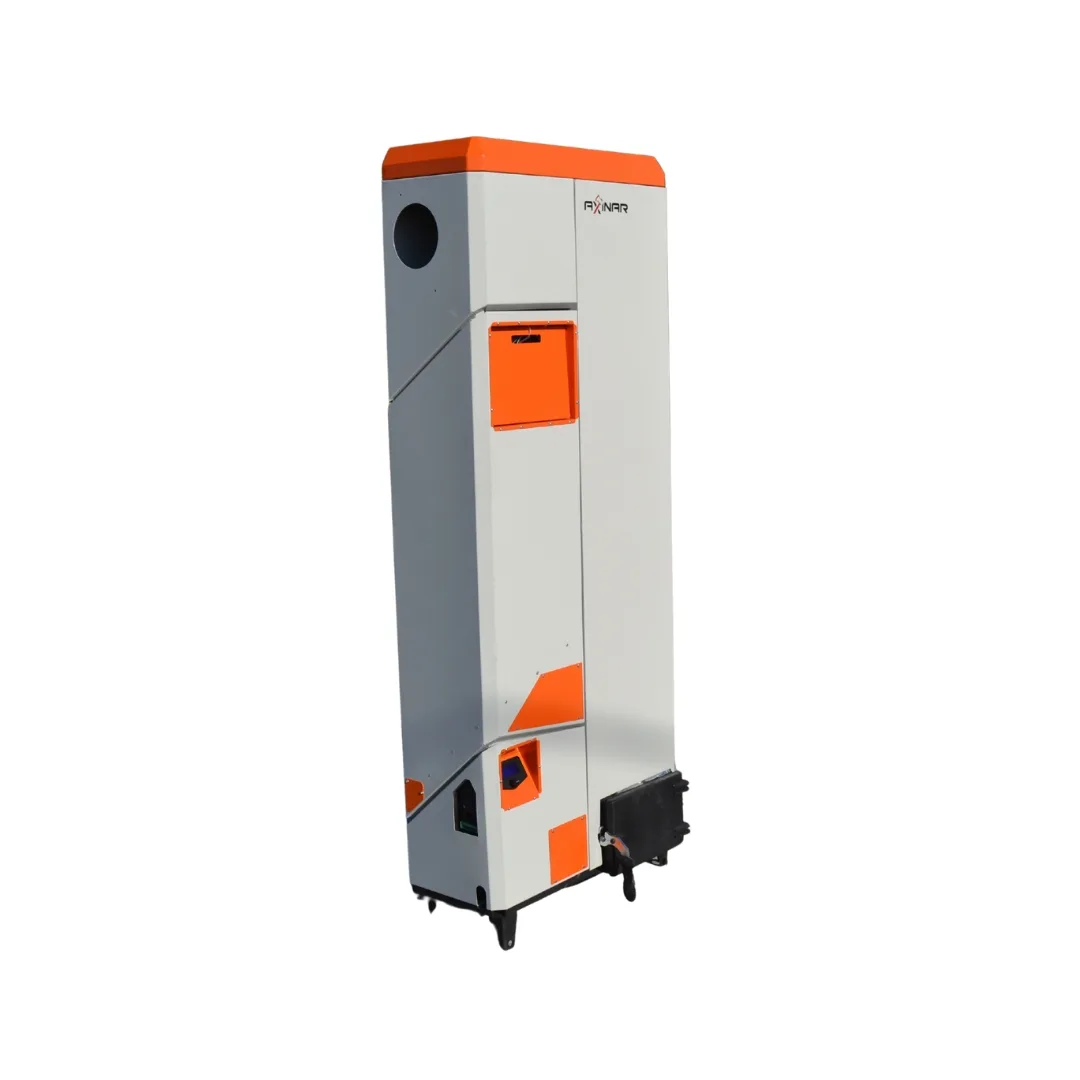


Wood Boilers, Selection Table
Wood boilers have slightly lower average efficiency (80-88%), so we typically choose 10-15% higher power than the pellet equivalent. Axinar produces:
- BM: base wood boilers
- BM_e: with lambda sensor and advanced software for precise combustion control
- PESKON: with integrated heat exchanger, economical solution
| Area | Power | Economical | Standard | Advanced (λ-sensor) |
|---|---|---|---|---|
| 100-150 m² | 25-35 kW |
PSK30
1.787,50€
|
BM30
2.387€
|
– |
| 150-250 m² | 35-60 kW |
PSK60
2.086,70€
|
BM60
2.932,60€
|
– |
| 250-400 m² | 60-95 kW | – |
BM90
3.137,20€
|
e_BM_e90
9.820,80€
|
| 400-700 m² | 95-150 kW | – | – |
e_BM_e150
16.368€
|
| 700-1200 m² (commercial) | 150-250 kW | – | – |
e_BM_e250
27.280€
|


Factors that Change the Required Power
1. Ceiling height
Standard calculation assumes 2.8-3 m ceiling. For higher:
- 3-3.5 m → +10%
- 3.5-4 m → +20%
- 4+ m (loft, hall) → +30-40%
2. Domestic Hot Water (DHW)
If the boiler will also supply DHW (bathroom/kitchen), add ~5 kW for 2-4 people. For larger families or boiler tank ≥ 200L, +8-10 kW.
3. Floor Heating vs Radiators
- Underfloor heating (~40°C): better efficiency
- Radiators (~60-70°C): standard calculation
4. Building exposure
- Mountainous / exposed slope: +15%
- Dense apartment building / middle floors: -10%
5. Window age
Old wood or aluminum → +10-15%. Modern energy-efficient (double glazing) → -5%.
What if I Choose a Boiler Bigger than I Need?
Many installers traditionally suggest “get slightly bigger for peace of mind”. This was bad practice. For modern modulating boilers:
- On/off cycling: more frequent starts + shutdowns = wear on electronics and chimney
- Lower efficiency: rarely operates at nominal power
- Higher consumption: not less, on the contrary
- Higher purchase and maintenance cost
Modern Axinar pellet boilers have 30-100% modulation, adapting power to demand without unnecessary cycles.
Climate Zones of Greece and Their Effect on Boiler Output
Greece is divided into 4 climate zones under the KENAK standard. Each zone has a different minimum design temperature (T_min), which determines the heat load and the boiler output required.
A practical example: a 130 m² house with moderate insulation. In Attica (Zone B) it needs around 17 kW. In Ioannina (Zone C) the same house needs around 22 kW. In Kozani (Zone D), around 26 kW. One house, three different solutions.
Underfloor Heating vs Radiators, and How Output Changes
The heat distribution system determines the mean flow temperature and affects the output calculation:
- Underfloor heating: Operates at low water temperature (35-45°C). Because the heat-emitting surface is large (the whole floor), high boiler output is not required. It can cut the required output by 10-15%.
- Radiators: Operate at high water temperature (65-80°C). The smaller surface area demands a greater heat flow. Work out an indicative figure using the tables above.
- Fan coil units: Operate at intermediate temperatures (45-60°C) with forced air circulation. Calculations are similar to radiators, perhaps 5% lower output.
- Underfloor heating combined with radiators: Needs a buffer tank or manifold to serve the different temperatures. The boiler is sized for the more demanding system (the radiators).
One important point: an oversized boiler on underfloor heating runs through a great many start-stop cycles, which lowers efficiency and increases wear. A better choice is a boiler with modulation (for example the CALOS CL8-32, adjustable from 8-32 kW).
Real-World Sizing Examples
Example 1: 85 m² Apartment, Athens
Data: Zone B (T_min -4°C), 2010-era insulation (double glazing, insulated envelope), family of three, heating only (no domestic hot water, as there is a separate electric water heater). Aluminium radiators.
Calculation: 85 m² × 110 W/m² (Zone B, moderate insulation) = 9,350 W = ~10 kW. Indicative choice: PELIT PL20 (20 kW). Although that is twice the figure, a modern boiler with modulation runs comfortably at lower outputs as well. Alternatively, if you can find a 10-12 kW model, better still.
Example 2: 165 m² Detached House, Thessaloniki
Data: Zone C (T_min -8°C), 2005-era insulation (5 cm thick), family of four with domestic hot water (200 L cylinder). Underfloor heating on the ground floor plus radiators on the first floor.
Calculation: 165 m² × 150 W/m² (Zone C, moderate insulation) = 24,750 W = around 25 kW, plus 5 kW for hot water for four people = 30 kW in total. Choice: PELIT PL30 (30 kW). Or BM30 for logs. A manifold is needed for the underfloor and radiator circuits.
Example 3: 250 m² Holiday Villa, Ioannina (Zone C, Mountainous)
Data: Zone C-D (T_min -10°C because of the altitude), poor insulation (1985 building), family of six, occupied periodically. Radiators.
Calculation: 250 m² × 200 W/m² (poor insulation in a cold zone) = 50,000 W = 50 kW, plus 8 kW for hot water = ~58 kW. Choice: BM60 (60 kW wood boiler) for long burn times in demanding conditions, or PELIT PL60 for fully automatic operation.
Example 4: 320 m² Commercial Premises, Kozani (Zone D)
Data: Zone D, T_min -12°C, poor insulation (1990 structure), office space open from 8 to 18 (8 h of heating a day). Heating only, no domestic hot water.
Calculation: 320 m² × 210 W/m² = 67,200 W. Because the system runs only 8 h a day, it needs an overhead of ~15-20% to reach setpoint quickly after the overnight cool-down = ~80 kW. Choice: the AXINAR commercial range with an 80-100 kW boiler, a buffer tank and an automatic PLC controller for time scheduling.
The Most Common Mistakes in Choosing Output
Two typical mistakes cost years of efficiency and hundreds of euros in running costs:
Over-sizing: “Better to have more than I need”
A 50 kW boiler in a house that needs 25 kW runs at 50% of its rated output. On pellet and wood boilers, that means:
- Multiple start-stop cycles every hour, with wear on mechanical parts, electrics and the burner.
- Reduced combustion efficiency, 5-10% lower efficiency overall, which means 10-15% more fuel.
- Higher emissions, with unburnt fuel at every start-up.
- A higher initial investment, for no benefit.
Under-sizing: “To keep the cost down”
A 20 kW boiler in a house that needs 30 kW runs permanently at 100%:
- It never reaches setpoint on the coldest days, which is uncomfortable for the occupants.
- Overheating of components, with a drastic reduction in service life.
- More frequent flue cleaning, because soot builds up faster.
- Wear on the heating pump, from running continuously at maximum.
The rule: Aim for a boiler that runs at 60-75% of rated output on the most demanding days. Modulating boilers (for example the CALOS CL8-32) give you 25-100% flexibility with no penalty.
Winter Design Temperatures (T_min)
The EN 12831 standard sets the minimum external design temperature (T_e,d) for each region, based on statistics from the Hellenic National Meteorological Service. This is the temperature that 98% of recorded values do not fall below over a 20-year period.
Indicative T_e,d values for major cities:
If the building sits higher than 400 m above sea level, subtract 1°C per 100 m from the figure for the nearest city. For example, Karpenisi (~950 m) in Zone C has a T_e,d of about -13°C rather than -8°C.
Frequently Asked Questions about Boiler Power
Need help choosing the right boiler?
Axinar manufactures pellet and wood boilers from 8 to 250 kW, all with EN 303-5 Class 5 certification and 5-year warranty.