Holiday home in Halkidiki with no utility connection. A farm in Thessaly used 5 to 6 months of the year. A container, cabin, or mountain hut. In all these cases there is one clear problem: how do you get hot water without grid power. A solar water heater with a built-in electric element is useless because the element has no supply.
The options are fewer than you might think, but clear.
Option 1: Closed-loop solar water heater, no element
The simplest choice. An indirect-circulation solar system with a 316 stainless tank and no backup element.
- Pros: no electrical component, zero consumption
- Cons: hot water only when the sun is out. Winter cloudy days, zero hot water. Frost in mountain locations, risk of pipe rupture without antifreeze.
- Fits: summer holiday homes, islands, low-altitude prefectures.
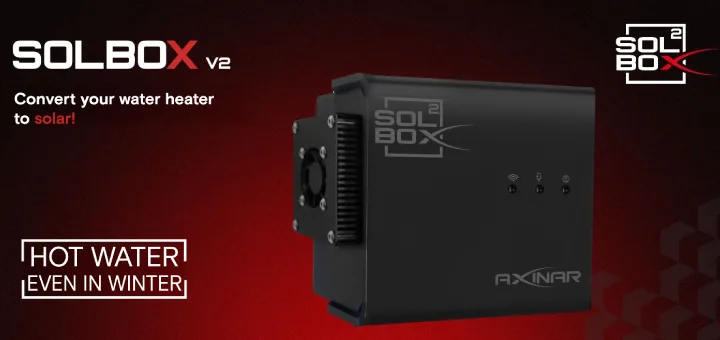
Option 2 (recommended): AXINAR SolBox, PV Panel + Water Heater
This is the most practical solution for off-grid hot water. The AXINAR SolBox is a DC controller purpose-built for this: one or two PV panels connect directly to the SolBox, which feeds the electric element of a typical 60/80/100 liter water heater. No batteries, no inverter, no grid connection.
How it works technically
The panel produces DC current (roughly 24 to 40V) when the sun is out. The controller takes that current and sends it to the water heater element. The element is a resistive load, it doesn’t care whether it gets DC instead of AC (in fact DC is more stable). Water heats slowly all day, reaches 60 to 70°C by evening, and the tank holds the temperature thanks to its insulation.
Advantages
- No plumbing on the roof (no leak risk)
- No antifreeze, no collector maintenance
- No batteries, no inverter
- Works in cloudy conditions (reduced power, but still heats)
- If you already have an electric water heater, you keep it
Disadvantages
- If water runs out in the evening, you wait for the next morning
- Continuous-use homes need a backup arrangement
Option 3: PV + inverter + batteries + electric water heater
Full off-grid system with batteries. This makes sense if the building already has an off-grid PV system installed for electrification.
- Pros: hot water any time, independent of instant sunlight
- Cons: battery cost, installation complexity, battery degradation (5 to 10 years)
- Fits: permanent off-grid homes where the system cost is already committed
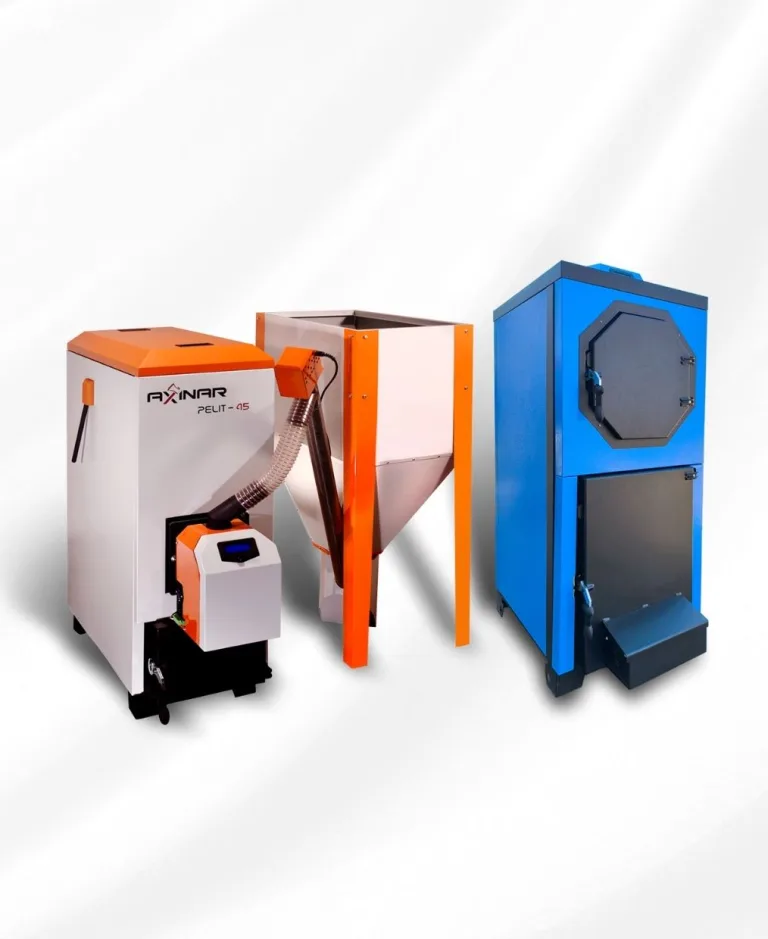
Option 4: Wood-fired hot water tank (backup only)
A wood boiler with a domestic hot water tank, used only in winter. Serves as backup when the sun isn’t enough.
Comparison for a typical holiday home
| Solution | Initial cost | Maintenance | Reliability in clouds |
|---|---|---|---|
| Solar without element | Low | Medium (antifreeze) | Zero |
| PV + AXINAR SolBox + water heater | Low to medium | Minimal | Medium |
| PV + inverter + batteries | High | Medium (batteries) | High |
Pitfalls to avoid
- Don’t connect a grid (AC) controller to an off-grid PV system: a grid controller needs stable 230V AC from the network to operate. In off-grid, the panel gives variable DC. You need a DC-dedicated controller like the AXINAR SolBox.
- Don’t place the panel on a shaded side: even partial shading drops output dramatically. A clear southern horizon is critical.
- Watch panel size: a 300 to 400W panel heats 60L in 4 to 5 hours of sun. For larger water heaters you need 2 panels.
SolBox is designed for holiday homes, farms and autonomous buildings without or with unstable grid supply. Direct DC current from panel to water heater.
- Family version for continuous use of 3 to 4 people
- Pro version for larger loads / 200L tanks
- No dependence on grid or inverter
- Free installation assessment
Request a quote
Send us the location, water heater type (if any), and use estimate. We reply within 24 hours with an equipment and installation proposal.
See also: SolBox: Complete guide to converting an electric water heater to solar.