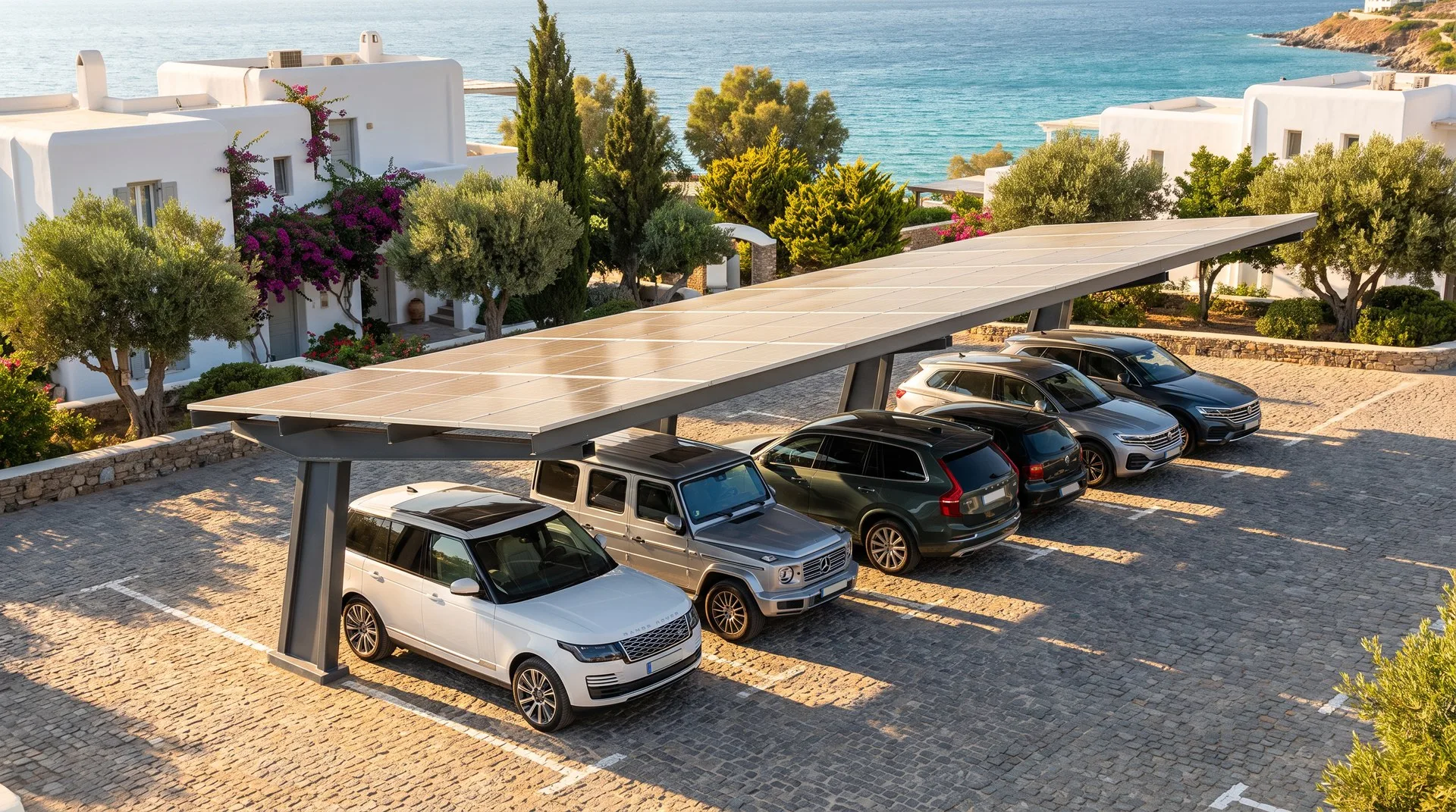
Permitting of photovoltaics in Greece was historically one of the most complex parts of installation. For solar carport specifically, the situation has simplified significantly in recent years, but critical points still exist that determine whether the project will complete in 1 month or 6 months.
Two Parallel Processes
For each solar carport there are two separate permitting parts:
- Building Permit (Structural): For the canopy construction, Planning Office or New Building Code (NOK)
- Electrical Connection: For grid connection with DEDDIE + RAAEY (depending on capacity)
1. Building Permit
Solar Carport as “Temporary Construction”
The New Building Code (NOK) provides for the category of temporary constructions that don’t require a building permit, provided specific limits are observed:
- Construction height (typically up to 3–3.5m)
- Area (typically up to 40m² for residences)
- Distance from plot boundaries
- Plot coverage (must not exceed allowed)
AXINAR notes in the technical dossier of the solar carport that up to 40m² a building permit is typically not required. This depends on building coefficients of the specific area, ask the local Planning Office.
Small Scale Permit (AMK)
If you exceed the limits but are under some smaller threshold, you need a Small Scale Permit, simpler and faster than a full building permit. Typically:
- Submission to Planning Office with drawings from architect or civil engineer
- Approval timeline: 15–45 days
Full Building Permit
For large solar carports (commercial spaces, industrial parking), approval time 3–6 months, higher cost and documentation.
2. Electrical Connection
Net Metering
Net metering allows connection of the PV system to the grid and transfer of produced energy:
- Capacity up to 10.8 kVA: Simplified process through DEDDIE (typically ~1–2 months)
- Larger capacity: Requires more documentation, role of RAAEY
Self-Consumption Without Grid (Off-Grid)
If solar carport connects only to EV charger or battery storage without grid connection, the process simplifies dramatically, no DEDDIE needed, only typical electrical installation.
Typical Project Timeline
| Phase | Time |
|---|---|
| System selection + static study (AXINAR free) | 1–2 weeks |
| Building permit (if needed) | 0–45 days |
| DEDDIE application (if grid-connected) | 1–2 months |
| Construction + PV installation | 1–3 weeks |
| Grid connection + activation | 2–4 weeks |
| Total (typically) | 2–4 months |
Practical Tips for Faster Permitting
- Prefer ≤ 40m²: If possible, design a carport that doesn’t require building permit
- Good pre-study: Detailed static study + electrical drawings save time on objections
- Start DEDDIE early: Electrical connection is usually the slowest part, submit application before construction begins
- Professional installer: Certified electrician for electrical study, avoids drawing returns
Indicative Legislative Framework
(Verify for current status at each point in time)
- Law 4685/2020: Modernization of Environmental Legislation, RES permitting procedures
- New Building Code (NOK): Temporary constructions, coverage, building coefficients
- Law 4964/2022: Energy market & net metering & RES
- RAAEY Regulatory Acts: For larger installations
- DEDDIE Guidelines: For electrical connection
AXINAR provides complete technical documentation for permitting: static study, electrical drawings, CE conformity declarations.
- Steel S420GD, Eurocode 1 design
- Bifacial PERC panels
- Free static study for permit
Request a Static Study & Quote
Send us your project basics, square meters, roof or ground type, zone, PV capacity, and we’ll respond within 24 hours with a recommended mounting system and free static study.