A solar water heater runs quietly for years, until one morning the water comes out lukewarm or you spot damp around the base on the roof. Solar with collectors and a backup electric element is mature technology, but it has its own failure points. Here are the 5 most common problems, what they mean, and the alternatives when replacement makes more sense than repair.
1. No hot water at all
First check: was there sun over the last few days? If yes, the cause is usually one of three:
- Backup element burned out: solar systems almost always have an electric element for cloudy days. If it burned out and the sun didn’t top it up, water stays cold.
- Thermal fluid in the collectors ran low or has air lock: in indirect collectors, glycol circulates between collector and tank. If it leaked out or air entered the loop, heat transfer stops.
- Broken thermostat: the tank thermostat is stuck and won’t let the backup element switch on.
2. Leak from the base of the tank
Water drips from the tank base or around collector fittings. Causes:
- Tank corrosion: the internal lining (glass, enamel, or 316 stainless) has degraded. Enamel typically fails after 10 to 15 years. 316 stainless lasts longer, but water quality and salinity play a big role.
- Aged flange gaskets: the rubber seal around the element flange fails in 8 to 12 years.
- Frost damage in collectors: if the thermal fluid is water-glycol at wrong concentration, a really cold night can burst copper piping.
3. Water heats up but runs out fast
Hot water for one shower, when it used to last three. Causes:
- Scale on the element: a lime layer reduces heat transfer. Same happens on internal heat exchangers.
- Scale in the tank: usable capacity drops as sediment builds up at the bottom.
- Worn tank insulation: starts at 90°C, drops to 40°C in 6 hours. Heat loss is worse than normal.
4. Water pressure keeps dropping
Needs constant refilling from the mains. Possible causes:
- Micro-leak at a collector fitting, hard to see because water evaporates
- Safety valve opening because pressure hits its trip point (typically 6 bar) on very hot days
- Thermal fluid escaping from the closed loop
5. The sun doesn’t “reach” (tank under a roof)
Apartment building with occupied roof, apartment with only under-roof placement, or a Mediterranean home where the roof is shaded in winter. In practice solar works fine in summer, but from November to February the electric element does almost all the work.
When repair makes sense vs replacement
| Tank age | What to do |
|---|---|
| 1 to 5 years | Repair. Element, gasket, or thermostat swap is simple and cheap. |
| 5 to 10 years | Check for corrosion. Repair if the issue is purely mechanical. |
| 10 to 15 years | Replacement usually makes more sense than repair, especially with enamel tanks. |
| 15+ years | Full replacement with a new solution, not a patch. |
The alternative: AXINAR SolBox
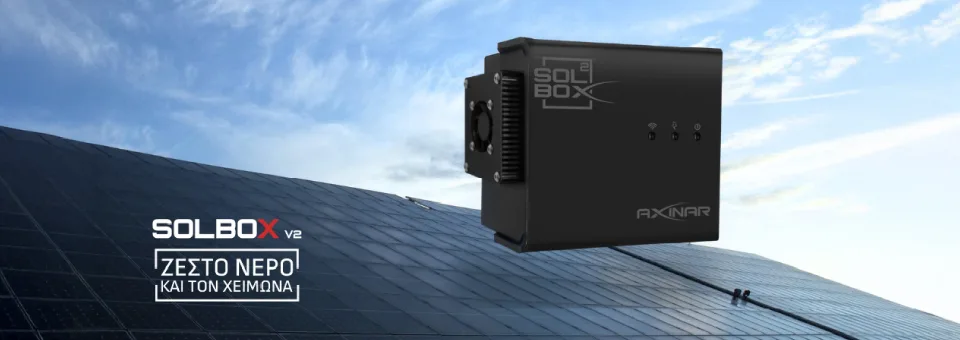
If the roof doesn’t fit a new solar tank, if collector placement is problematic, or you simply want a solution without plumbing on the roof, the next step is not another solar water heater. The clean solution is the AXINAR SolBox: a PV panel connects to a DC controller that feeds power directly to the electric element of your existing water heater. Hot water from the sun, with no piping, no antifreeze, no collector maintenance.
Why SolBox instead of another solar water heater
- No plumbing on the roof, zero leak risk over 10 to 15 years
- No antifreeze, zero maintenance every 5 years
- No inverter, no grid connection, simple 2 to 3 hour install
- Works with your existing electric water heater 40 to 200L, no tank replacement needed
- 3 versions (Light / Family / Pro) depending on usage
When it fits
| Scenario | Solution |
|---|---|
| Solar 1 to 5 years old with a small fault | Repair |
| Solar 15+ years, tank leaking | AXINAR SolBox (replacement) |
| Roof occupied or not allowed | AXINAR SolBox on the balcony |
| No grid connection (holiday home) | AXINAR SolBox off-grid |
| New electric water heater, want lower running cost | AXINAR SolBox (no tank change) |
SolBox turns your existing electric water heater into a solar one, with a PV panel and a DC controller box. No grid connection. No plumbing changes.
- Works with any electric water heater 40 to 200L
- No inverter or DEDDIE permit required
- Install in 2 to 3 hours by a partner technician
- 3 versions (Light / Family / Pro) depending on your needs
Request a quote
Send us a photo of your existing water heater and the site, and we’ll suggest the right SolBox version with a full installation plan.
See also: Complete guide to converting an electric water heater to solar with SolBox, or PV water heater vs solar vs heat pump comparison.