Two machines dominate sheet metal bending: the press brake (classic bending press) and the panel bender. Similar in general function, they bend sheet metal to a predetermined angle, but with completely different philosophy, ideal products, and economic logic.
Press Brake (Classic)
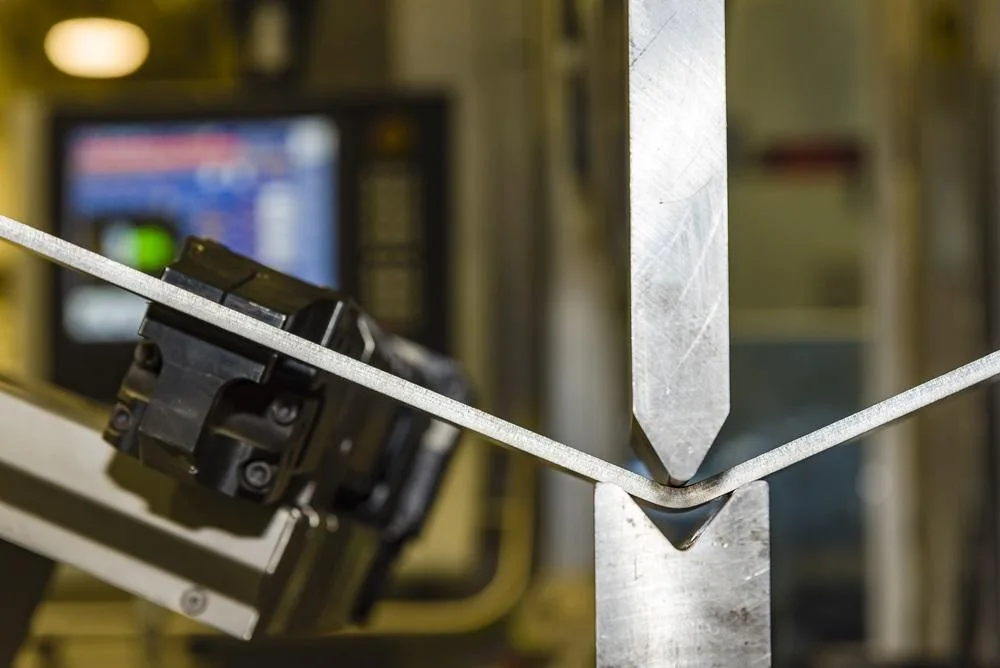
The most widespread type of bending for decades. Sheet metal is placed on a V-die, and a descending tool (punch) presses it downward, creating a bend.
- Principle: Pressure via punch + die (V-die), one bend at a time
- Requires operator: To flip the piece between bends
- Tooling: Many (punches + dies in different profiles), change per job
- Thickness: 0.5 to 25+ mm depending on machine tonnage
- Ideal for: Thick sheet, large batches of same part, simple geometries
- Precision: ±0.3° with proper tooling
Panel Bender
Modern machine that bends the sheet with automatic top and bottom tools, without operator rotation. The Salvagnini panel bender AXINAR uses bends whole boxes in one setup.
- Principle: Top-bottom moving tools in automatic configuration
- Requires operator: Minimally, the piece is loaded once and all bends happen automatically
- Tooling: Universal, no change between jobs
- Thickness: 0.4 to 3.2 mm typically (on Salvagnini P4)
- Ideal for: Cabinets, panels, complex geometries with many bends, small-medium series
- Precision: Salvagnini’s official spec for P4 is ±0.2 mm interior line, repeatability ±0.1 mm
Comparison Table
| Press Brake | Panel Bender | |
|---|---|---|
| Sheet thickness | 0.5–25+ mm | 0.4–3.2 mm |
| Angle precision | Variable | ±0.05° (per Salvagnini P4 spec) |
| Time per part (4-side box) | Manual rotation between bends | Automatic sequence, faster |
| Manual labor need | High (rotation per bend) | Low (auto) |
| Setup per job | Tool change needed | Program parameterization |
| Ideal batch | Large | Small-medium |
| Machine cost | Low-medium | High |
When Each
Press Brake, Ideal When:
- You have sheet thickness above 3.5mm (frames, structural)
- You produce large batches of the same part (e.g. 1,000+ pieces)
- Simple geometry with 1–3 bends
- Pressing force is critical (heavy-duty applications)
Panel Bender, Ideal When:
- Sheets between 0.4–3mm (control panels, electronic enclosures)
- Complex geometries with 4+ bends
- Small to medium series with frequent product changes (mass customization)
- High angle precision required
- You want minimum manual time and high productivity
How Fast in Practice
Salvagnini reports for the P4 up to 17 bends per minute. Actual time for a complex part depends on number of bends, material thickness, and geometry, but automated handling eliminates the manual rotation intervals that dominate a press brake workflow.
How the Blank Holder + Counter Blade Mechanism Works
The panel bender mechanism differs fundamentally from press brake:
- Blank Holder (bottom): Fixed plate holding the sheet in place
- Counter Blade (top): A second clamp securing the piece from above
- Universal bending blades: Two separate blades, one top and one bottom, producing lateral push. Depending on the selected blade (up or down), material bends upward or downward, without needing to rotate the piece.
Smart Sensors & Springback Compensation
Modern Salvagnini panel benders feature sensors that measure actual sheet thickness and material temperature, and automatically adjust bend angle for springback compensation (the phenomenon of material “returning” toward original position after pressure). The result is consistent quality on every piece of the series, without manual adjustment by operator.
Lights-Out Operation & Ergonomics
An important economic advantage of panel benders is the possibility of “lights-out” operation: a series is programmed in the morning, a stack of raw sheets is loaded, and the machine works all night autonomously. The operator returns the next morning to a batch of finished parts.
On the press brake, the operator is constantly required: piece movement, back-gauge setting, foot-pedal control. For large sheets, manual handling may require a second operator for safe management.
Special Press Brake Tools, Where Panel Bender Isn’t Enough
Despite panel bender advantages, press brake remains the only option for certain geometries:
- Gooseneck punches: “Goose neck” allowing bending in deep boxes where the rest of the structure would prevent it
- Narrow punches: Very narrow blades for bending in tight spaces or between other protrusions
- Radius tools: For controlled large-radius bending (e.g. decorative plates)
- Large-opening V-dies: For thicknesses > 5mm where panel bender doesn’t reach
Ideal Products for Panel Bender
Panel bender delivers maximum result on:
- Cabinets & boxes: Control panels, automation cabinets, electrical boxes, server enclosures
- Appliance housings: Home appliances, medical equipment, POS terminals
- Lighting fixtures: LED panel frames, residential & commercial fixtures
- Architectural panels: Building facades, railings, covers
- Lids & boxes: Anything with 4+ sides that must assemble with precision
Typical limits (Salvagnini P4): sheet width up to 1600 mm, diagonal up to 2500 mm, bend height up to 165 mm. Thicknesses: steel up to 11 gauge (~3 mm), stainless up to 14 gauge (~2 mm), aluminum up to 3.8 mm.
AXINAR operates modern Salvagnini panel bender for cabinets, panels, electrical enclosures and anything requiring complex geometry with high precision.
- Sheet up to 4m length
- Thicknesses 0.4–3.2mm on Salvagnini
- Steel, inox, aluminum, galvanized
Request a Quote for Your Project
Send us sketches, CAD drawings, or a description of your project, and we’ll respond within 24 hours with a technical estimate. We cover everything from prototypes to mass OEM production.
See also bending in steel/inox/aluminum or all AXINAR processes.